Sunday, 24 February 2013

Credits


Opening Credits

The opening credits are crucial in any movie or TV programme because it (along with the closing credits) introduces the actors, directors etc. However, the opening credits tend to be shorter so therefore only introduce the main actors, production company, distribution company, directors, producers etc.


Common opening credits order

There is no written law in which order the credits should appear but there seems to be an average order

Name Of The Studio

Name of studio that distributed the film - Sony, 20th Century Fox, Columbia etc.

Name Of Production Company

Name of production company that actually produced the film or name of people who have invested in the film.

Name Of Producer And Director

One of the most important credits - the names of the producer(s) and directors(s)

Film Title

Almost the climax of the credits, the revealing of the film title

"Starring"

Credits the main actors. Usually around 7 or 8 names are credited 

Casting

Names of the people who directed the casting of the actors for the movie

Music By

Credits the person the score of the movie


Below are a few examples that follow these average guidelines 


"Catch Me If You Can"


"The Girl With The Dragon Tattoo"


"Reservoir Dogs"

Sound


In the opening scene of "Snatch" there is dialogue throughout the scene along with contrapuntal Jewish-themed music which matches with the characters on screen (4 Jewish men). The music keeps the scene very light-hearted and doesn't create too much suspense and gives the audience some idea of how the movie will turn out in terms of intensity. This has taught me that how your opening sequence sounds aswell as looks will set the tone for the rest of the movie, as is the case in this particular movie. This has also showed me that you can have both, dialogue and music without one overshadowing the other


Sunday, 6 January 2013

Representation

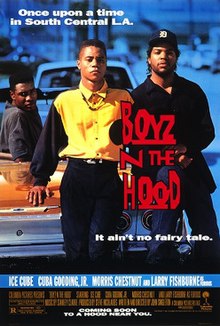
Boyz N The Hood

The 1991 film "Boyz N The Hood" depicts life in early 90s South Central Los Angeles and mostly the lives of Black minorities living in very poor areas of America. Since it's release it has seen a great deal of social and cultural impact. It portrays the main characters as being very violent, disobedient to the law and money hungry, even from a very young age which is meant to be a representation of young black minorities living in America at the time.
 The film follows a group of friends who re unite after one of the main characters Doughboy returns from a 7 year period in prison for a shop robbery when he was just 14 years old. This is again highlights the fact that even at a young age, the minorities living in these areas are prone to crime and violence and is seen as a very common thing. A running theme in the film is gang violence and how a large portion of the black community are in gangs as a way of making money and gaining protection. There are various encounters between Doughboy and his friends and a rival gang from another neighborhood. These encounters usually pass without any violence but gradually build up to the point where gun shots are fired and the two gangs begin to engage in a "gang war". 2 of the characters, Ricky and Tre who are part of Doughboy's group are considered to be the more conscious characters who have ambitions of gaining an education and moving out of the poverty they live. They often try to distance themselves from trouble but as the film depicts, no matter where they go there will always be trouble because of the area they are living in. The film tries to rise this issue that black minorities have when living in these types of areas. Ricky's (the brother of Doughboy) character was described at the time as a metaphor for "hope" for minorities living in poverty. Ricky's character is a talented american football player and is hoping to gain a scholarship in order to go to college depending on the score he gets on an SAT test and often makes references to himself leaving leaving his neighborhood to play in the NFL. This often angers the rest of his group as they are considered to be "in too deep" and are destined to die due to a life of crime as this is all they have. This issue of being destined to die in "the hood" is often referenced in the film and is seen as a common issue for blacks living in urban areas at the time. Ricky and Tre both take SAT tests in order to go to college and gain further education. This is seen as a rare opportunity for people coming from their background. This is shown in the film because Ricky, Tre and a female are the only black people taking the test in the school. Later that day, Rick and Tre run into a rival gang and Ricky tries to protest he wants no trouble with any gangs but is shot dead because he is the brother of Doughboy. Doughboy later goes on to kill the gang member who killed his brother. A few days later Tre receives both his and Ricky's test scores and it is revealed that they both received the score they needed in order to go to college. It again raises highlights that most of these young black men are destined be killed in their own neighborhood at any given time simply because of where they live. The film reveals at the end that Doughboy was killed on the day of Ricky's funeral and that Tre would go on to Spellman college.  

Genre

Crime/Gangster                                  
The Conventions
  • Often highlights the life of a crime lord/victim
  • Often set in big cities and portrays the gritty crime underworld in contrast to the glitz and glamour of the city like the nightclubs, fast cars and sophisticated women
  • Glorifies the rise and success of a crime lord or highlights the downfall of someone who is a victim of crime
  • A series of small crimes occur before an eventual big crime which is usually the main crime in the film e.g bank robbery, murder, kidnapping etc.
  • Sometimes separate stories in the film eventually intertwine with each other to conclude the film
  • Usually a power struggle occurs or someone tries to takeover the kingpin in the movie 
  • Sometimes two enemies or rival gangs must work together in order to take down the "bad guy"
  • Usually concludes with a big shootout in which the main character either dies or survives and gets away before any police arrive with a substantial amount of money  

"Scarface"


"Scarface" depicts the rise and fall of a Cuban immigrant living in Miami, FL. Tony Montana arrives as an immigrant with nothing to his name but uses crime to make money and eventually build an empire. This film stereotypes the "Gangster/Crime" particularly well because it follows the life of someone who has nothing but uses crime to acquire money, women and wealth but is eventually caught up with by the life of crime. The film shows the rise and fall of a crime lord which is usually a convetion for a crime/gangster movie.

"Cartlio's Way"


Carlito's Way is a film about a former gangster (Carlito Brigante) who escapes 30 years in prison thanks to his corrupt lawyer, David Kleinfeld. The film is about how Brigante wants to escape his past and turn his life around but the glamour of the life of crime continues to pull him back in. This again depicts the genre well because it shows how no matter how hard someone tries to escape their past, the benefits of a life of crime are just too much to resist. The film portrays his life as very glamorous as Brigante is usually in expensive night clubs, dressed in expensive suits and accompanied by sophisticated women, all stereotypical conventions of a crime film.


"Lock Stock & Two Smoking Barrels"


"Lock Stock & Two Smoking Barrels" is a film about 4 friends who find themselves in debt to a crime lord over a game of card. They must find £500,000 within a week or they could be facing the worse. Although the film has a comedic side it still represents the genre well by showing how sometimes crime is sometimes the only answer when you need money fast. The film portrays many violent (although, lighthearted) scenes which is stereotypical for a movie of this genre.

Institution: Film Industry


Institution

We were was asked to produce a brief for a new film. This was to be presented on a powerpoint in front of the whole class and had to include a main story, cast, director and distribution company.

My groups idea was a low budget horror film titled "Bloody Creek". We chose Niel Marshall as our director as he has directed some successful low budget horror films such as "Dog Soldiers" and we felt he would be perfect for our film. 

Our storyline was a group of boys go on a lads holiday to a cabin on an uninhabited island. They plan on spending a week there and doing a lot of extreme sports. They crash their boat through drunken antics and are stuck on the island, and it will take 2 days until the coastguard can get out to them This doesn't bother them until everything goes from bad to worse and they unleash a curse and are attacked by a group of zombies.'

When casting our film we needed to pick  British actors and in the end we decided on Danny Dyer, Noel Clarke, Stephen Graham and Joseph Gilgun as the "Lads" and Helena Bonham Carter and Gerard Butler as the head zombies. 
When given feedback by the class it was pointed out that Helena Bonham Carter was a bad choice for an actress in our film as she is used to bigger Hollywood films rather than smaller independent British films.

When choosing a distribution company we decided on Momentum films as it is an independent film company and has distributed low budget horror films similar to ours such as "River of Darkness",  "Death Cert" and "The Killing Room" so our film would appeal to them. 

Narrative


Narrative


Todorov proposed a basic structure for all narratives. He stated that films and programmes begin with an equilibrium, a calm period. Then agents of disruption cause disequilibrium, a period of unsettlement and disquiet. This is then followed by a renewed state of peace and harmony for the protagonists and a new equilibrium brings the chaos to an end. The simplest form of narrative (sometimes referred to as ‘Classic’ or ‘Hollywood’ narrative).


A classic narrative pattern that could occur would be:
  1. Equilibrium- This is when everything is at peace and all is in order at the beginning of the narrative
  2. Disruption- Something happens which is normally bad and disrupts the peace and normality of things
  3. Recognition- There is recognition that the disruption has occurred
  4. Repair- There is an attempt to fix the disruption and return to it's normal state 
  5. New equilibrium - The problem has been solved and the narrative returns to it's normal state

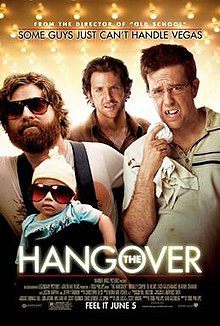
The Hangover

The 2009 film "The Hangover" follows this narrative pattern.

1. Equilibrium - Everything is in order. Doug is getting married so him and his 3 friends decide to go to Las Vegas for a stag party. They get extremely drunk and spend the night out on the Las Vegas strip.

2. Disruption - Phil, Alan And Stu wake up in their penthouse suite extremely hungover and no recollection of the previous night's events

3.  Recognition - Phil, Alan and Stu realize the groom Doug is missing on the day of his wedding 

4. Repair -  Phil, Alan and Stu must retrace their steps of the previous night by visiting various locations around Las Vegas in order to find Doug. With each location they think they have finally found Doug but it turns out to be someone or something completely different 

5. New equilibrium - Stu figures out that Doug is on the roof of the hotel and they rescue him just in time to quickly drive to his wedding ceremony. Doug then gets married and he, Phil, Alan and Stu remissness on the previous after finding out Alan had photographed the entire night. 


Institution: Distribution and Prodcution

Distribution
Distribution is one of, if not, the most important step in making a film. Ever wondered why so many awful movies make so much in the box office? Put that down to distribution  Distribution companies will only pick films that they think will be a commercial success. Usually films with an A-List cast and a strong, obvious storyline. Distrubution companies are in charge of doing everything to make sure people hear about their movie and want to go and see it. Depending on how big the company is, they will usually have huge advertising campaigns like bus ads, internet trailer and billboards. 

One well known Distribution Company is Revolver Entertainment. They are a British company who also work out of Los Angeles.  Some of their notable successes are: Kidulthood & Adulthood, Anuvahood And Sherlock Holmes 


    Production

    Production companies are responsible for the overall prodctuion of the film. This includes; scripting, scheduling, post production, distributing, marketing and budgeting the film. Production companies are often a company within a big film studio which as known as the "parent company". This means they exclusively work with films that their parent company are making.


    One major British production company is BBC Films. They often work with major UK and international distributors and have produced or co-produced some of the most successful British films of recent years, including An EducationStreetDance 3DFish TankStage BeautyA Cock and Bull StoryNativity! and Match Point.