Sunday, 28 April 2013

Tuesday, 12 March 2013
Art Of The Title
The artwork of the opening titles is important. The animation, colour etc. of the titles is vital because it gives the audience an idea of what type of film they are about to watch. There can be many different ways in which the opening titles and credits can be presented. It's all based on how much they want to reveal of the film from the opening credits. Some films may have a simple white font over a black background. Some films may have different colours, font styles and transitions.
"Enter The Void"
The artwork of the opening credits for "Enter The Void" is one that has opted for constantly various font styles and colours. The credits start with a quickly flashing font and the credits only appear for 1 or 2 seconds which, along with the flashing font, create a delirious & disorientated effect which goes along with the theme of the rest of the film. As the main credits of the film begin, it keeps the same theme as the opening credits but instead of keeping with one font, there is a different font for each credit. The fonts are those which are usually seen on neon signs outside of nightclubs in big cities which is again a theme of the movie. As the credits go on, the animations become more over the top and complex and the transitions between the credits become a lot quicker. This creates tension and gives the audience an idea that it is building up to something big but instead suddenly cuts to black and then returns to the original font with "ENTER THE" across the screen before the film begins. The artwork and animations in these opening credits are highly effective because it makes it hard for the audience not to have the full attention on the screen, which is what the editors would have wanted.
Sunday, 24 February 2013
Credits
Opening Credits
Common opening credits order
There is no written law in which order the credits should appear but there seems to be an average order
Name Of The Studio
Name of studio that distributed the film - Sony, 20th Century Fox, Columbia etc.
Name Of Production Company
Name of production company that actually produced the film or name of people who have invested in the film.
Name Of Producer And Director
One of the most important credits - the names of the producer(s) and directors(s)
Film Title
Almost the climax of the credits, the revealing of the film title
"Starring"
Credits the main actors. Usually around 7 or 8 names are credited
Casting
Names of the people who directed the casting of the actors for the movie
Music By
Credits the person the score of the movie
Below are a few examples that follow these average guidelines
"Catch Me If You Can"
"The Girl With The Dragon Tattoo"
"Reservoir Dogs"
Sound
In the opening scene of "Snatch" there is dialogue throughout the scene along with contrapuntal Jewish-themed music which matches with the characters on screen (4 Jewish men). The music keeps the scene very light-hearted and doesn't create too much suspense and gives the audience some idea of how the movie will turn out in terms of intensity. This has taught me that how your opening sequence sounds aswell as looks will set the tone for the rest of the movie, as is the case in this particular movie. This has also showed me that you can have both, dialogue and music without one overshadowing the other
Sunday, 6 January 2013
Representation
Boyz N The Hood
 The 1991 film "Boyz N The Hood" depicts life in early 90s South Central Los Angeles and mostly the lives of Black minorities living in very poor areas of America. Since it's release it has seen a great deal of social and cultural impact. It portrays the main characters as being very violent, disobedient to the law and money hungry, even from a very young age which is meant to be a representation of young black minorities living in America at the time.
The film follows a group of friends who re unite after one of the main characters Doughboy returns from a 7 year period in prison for a shop robbery when he was just 14 years old. This is again highlights the fact that even at a young age, the minorities living in these areas are prone to crime and violence and is seen as a very common thing. A running theme in the film is gang violence and how a large portion of the black community are in gangs as a way of making money and gaining protection. There are various encounters between Doughboy and his friends and a rival gang from another neighborhood. These encounters usually pass without any violence but gradually build up to the point where gun shots are fired and the two gangs begin to engage in a "gang war". 2 of the characters, Ricky and Tre who are part of Doughboy's group are considered to be the more conscious characters who have ambitions of gaining an education and moving out of the poverty they live. They often try to distance themselves from trouble but as the film depicts, no matter where they go there will always be trouble because of the area they are living in. The film tries to rise this issue that black minorities have when living in these types of areas. Ricky's (the brother of Doughboy) character was described at the time as a metaphor for "hope" for minorities living in poverty. Ricky's character is a talented american football player and is hoping to gain a scholarship in order to go to college depending on the score he gets on an SAT test and often makes references to himself leaving leaving his neighborhood to play in the NFL. This often angers the rest of his group as they are considered to be "in too deep" and are destined to die due to a life of crime as this is all they have. This issue of being destined to die in "the hood" is often referenced in the film and is seen as a common issue for blacks living in urban areas at the time. Ricky and Tre both take SAT tests in order to go to college and gain further education. This is seen as a rare opportunity for people coming from their background. This is shown in the film because Ricky, Tre and a female are the only black people taking the test in the school. Later that day, Rick and Tre run into a rival gang and Ricky tries to protest he wants no trouble with any gangs but is shot dead because he is the brother of Doughboy. Doughboy later goes on to kill the gang member who killed his brother. A few days later Tre receives both his and Ricky's test scores and it is revealed that they both received the score they needed in order to go to college. It again raises highlights that most of these young black men are destined be killed in their own neighborhood at any given time simply because of where they live. The film reveals at the end that Doughboy was killed on the day of Ricky's funeral and that Tre would go on to Spellman college.
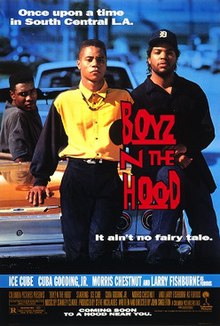 The 1991 film "Boyz N The Hood" depicts life in early 90s South Central Los Angeles and mostly the lives of Black minorities living in very poor areas of America. Since it's release it has seen a great deal of social and cultural impact. It portrays the main characters as being very violent, disobedient to the law and money hungry, even from a very young age which is meant to be a representation of young black minorities living in America at the time.
The film follows a group of friends who re unite after one of the main characters Doughboy returns from a 7 year period in prison for a shop robbery when he was just 14 years old. This is again highlights the fact that even at a young age, the minorities living in these areas are prone to crime and violence and is seen as a very common thing. A running theme in the film is gang violence and how a large portion of the black community are in gangs as a way of making money and gaining protection. There are various encounters between Doughboy and his friends and a rival gang from another neighborhood. These encounters usually pass without any violence but gradually build up to the point where gun shots are fired and the two gangs begin to engage in a "gang war". 2 of the characters, Ricky and Tre who are part of Doughboy's group are considered to be the more conscious characters who have ambitions of gaining an education and moving out of the poverty they live. They often try to distance themselves from trouble but as the film depicts, no matter where they go there will always be trouble because of the area they are living in. The film tries to rise this issue that black minorities have when living in these types of areas. Ricky's (the brother of Doughboy) character was described at the time as a metaphor for "hope" for minorities living in poverty. Ricky's character is a talented american football player and is hoping to gain a scholarship in order to go to college depending on the score he gets on an SAT test and often makes references to himself leaving leaving his neighborhood to play in the NFL. This often angers the rest of his group as they are considered to be "in too deep" and are destined to die due to a life of crime as this is all they have. This issue of being destined to die in "the hood" is often referenced in the film and is seen as a common issue for blacks living in urban areas at the time. Ricky and Tre both take SAT tests in order to go to college and gain further education. This is seen as a rare opportunity for people coming from their background. This is shown in the film because Ricky, Tre and a female are the only black people taking the test in the school. Later that day, Rick and Tre run into a rival gang and Ricky tries to protest he wants no trouble with any gangs but is shot dead because he is the brother of Doughboy. Doughboy later goes on to kill the gang member who killed his brother. A few days later Tre receives both his and Ricky's test scores and it is revealed that they both received the score they needed in order to go to college. It again raises highlights that most of these young black men are destined be killed in their own neighborhood at any given time simply because of where they live. The film reveals at the end that Doughboy was killed on the day of Ricky's funeral and that Tre would go on to Spellman college.
Subscribe to:
Posts (Atom)